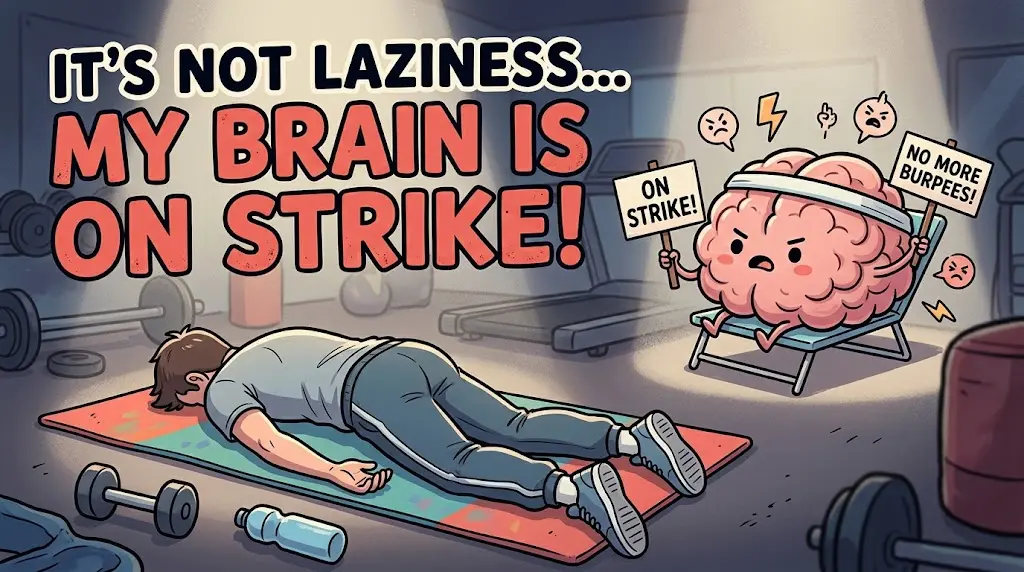
You sign up for a gym membership, but instead of actually working out, you end up using the facility merely as a place to shower; you vow to go for morning runs and set a dozen alarms, only to hit “snooze” on every single one; you finally manage to get moving, but give up completely after a few days because it feels too exhausting or painful…
At moments like these, many people fall into a spiral of self-reproach: “Am I just too lazy?” “Why can others be disciplined while I can’t?”
In reality, it’s not your fault; your brain might simply be “going on strike.”
For many people—especially those dealing with high stress or anxiety—the difficulty in starting or maintaining an exercise routine isn’t due to a lack of willpower. Instead, it is the brain’s defense mechanisms that are holding them back.
People facing psychological stress or anxiety often encounter a paradox: they know that regular exercise benefits both physical and mental health and genuinely want to improve themselves through it. However, the hurdle of getting started is immense, and the process itself feels agonizing, making consistency nearly impossible. Consequently, exercise becomes yet another source of stress, trapping them in a vicious cycle.
The physical sensations experienced during exercise are identical to those of an anxiety attack. Extensive epidemiological and clinical research has shown that higher levels of anxiety correlate with lower levels of physical activity and poorer adherence to exercise routines. A key reason for this is that individuals suffering from anxiety or panic disorders often possess heightened “anxiety sensitivity.”
Anxiety sensitivity refers to the degree to which a person is sensitive to the sensation of anxiety itself. When an objectively stressful event occurs—such as a boss losing their temper—someone with low anxiety sensitivity might simply think, “Damn, this is a hassle.” In contrast, someone with high anxiety sensitivity might panic, thinking, “Oh no, this is a disaster; I’m so anxious.”
Similarly, when exercise causes physiological changes like a racing heart, rapid breathing, or sweating, a person with low anxiety sensitivity recognizes these as normal reactions to physical exertion. However, someone with high anxiety sensitivity may misinterpret these sensations as signs of an anxiety attack—because a racing heart, rapid breathing, and sweating are precisely the physiological symptoms associated with anxiety and panic episodes. Anxiety sensitivity causes the brains of individuals with anxiety and panic disorders to misinterpret normal physiological states associated with exercise as threats; perceiving a loss of physical and mental control, they instinctively avoid these states.
A core mechanism that sustains anxiety disorders is the use of avoidance to achieve a fleeting sense of calm. Once exercise is perceived as a threat, avoiding it provides temporary relief from anxiety. This brief respite reinforces the avoidance behavior, making it increasingly difficult to initiate exercise in the future.
The thought of exercise triggers tension → the individual chooses not to exercise → anxiety subsides. The brain learns that avoiding exercise ensures safety; in an effort to maintain this sense of security, exercise comes to be viewed as a chronic stressor.
Of course, individuals with anxiety disorders often lack the physical energy to exercise. Chronic activation of the HPA axis and the body’s arousal systems leads to subjective fatigue, making it difficult to get moving. Furthermore, many suffer from social anxiety; the mere thought of leaving the house to exercise can be a significant deterrent.
Once the initial hurdle is cleared, however, anxious individuals are actually more likely to fall in love with exercise.
Research indicates that exercise interventions can significantly reduce anxiety symptoms; consequently, psychologists and psychiatrists strongly encourage patients with anxiety disorders to engage in physical activity.
Interestingly, while it is difficult for those with anxiety and panic disorders to start exercising, they are often more likely to develop a passion for it once they begin. Because anxious individuals have high baseline anxiety and chronically activated sympathetic nervous systems, the reduction in anxiety resulting from exercise is more pronounced. In other words, the “reward” derived from exercise is greater for them than for the average person; this explains the high prevalence of individuals with a history of anxiety among long-distance runners, cyclists, and strength training enthusiasts.
For individuals with anxiety disorders, starting an exercise routine requires a gentle approach known as interoceptive exposure therapy.
Interoceptive exposure is a cognitive-behavioral technique specifically designed to treat panic disorder and high anxiety sensitivity. It involves actively and safely inducing physical sensations that mimic anxiety, thereby teaching the brain that these sensations are not dangerous. It is best to start with low-barrier exercises—activities characterized by low intensity, a predictable environment, and the flexibility to stop at any moment. If necessary, you can begin with sessions as short as 5 or 10 minutes.
Try starting your exercise routine this way:
- Brisk walking (or casual strolling)
Research shows that regular walking helps alleviate anxiety. Simple walking—whether casual or brisk—activates the body without triggering the brain’s threat-response system. Walking keeps your physical state within a controllable range: heart rate rises gradually, you can stop whenever you wish, and the lack of strict situational requirements helps reduce social pressure.
The ideal approach is to walk for 10 to 20 minutes on more than five days a week, aiming for a pace where you feel a light sweat but can still speak in complete sentences.
- Rhythmic exercises (involving repetitive, fixed rhythms and movements)
An anxious brain dislikes unpredictability. Therefore, engaging in exercises with fixed rhythms and movements—such as low-resistance cycling, incline walking on a treadmill, or using a rowing machine—can be beneficial.
Rhythmic exercise synchronizes breathing, the vestibular system, and the vagus nerve; many studies suggest this is a key mechanism by which exercise combats anxiety.
- Low-intensity strength training (short movements, high sense of control)
Strength training is actually highly suitable for many people with anxiety. The movements are brief and can be paused, offering a strong sense of control while allowing you to focus intensely on the physical actions themselves.
Simple exercises using dumbbells, resistance bands, or body weight are all viable options. However, it is important to control the weight and intensity at the start and increase them gradually; excessive stimulation could potentially trigger anxiety sensitivity.
Conclusion:
Many people suffering from anxiety disorders are not simply “lacking self-discipline”; rather, they are living with a chronically over-activated nervous system. When the body remains in a state of constant readiness to face danger, it is difficult for the brain to truly relax. Exercise alleviates anxiety not by “burning off excess energy,” but by recalibrating the nervous system, gradually shifting the body from a state of constant high alert back to a sense of safety. This explains why numerous studies have found that even low-intensity activities, such as walking, can consistently lower anxiety levels.
For those dealing with anxiety, exercise need not be intense or perfect. What truly matters is allowing the brain to repeatedly experience that physical arousal is safe—and that one can maintain a sense of control while feeling those sensations.
If you are living with anxiety, try starting with very small goals. The aim isn’t to get thinner, build strength, or prove your willpower; it is simply to give your nervous system a gentle reset.